Wunda Chair Pilates: Benefits, Exercises, and Why It Belongs in Your Practice
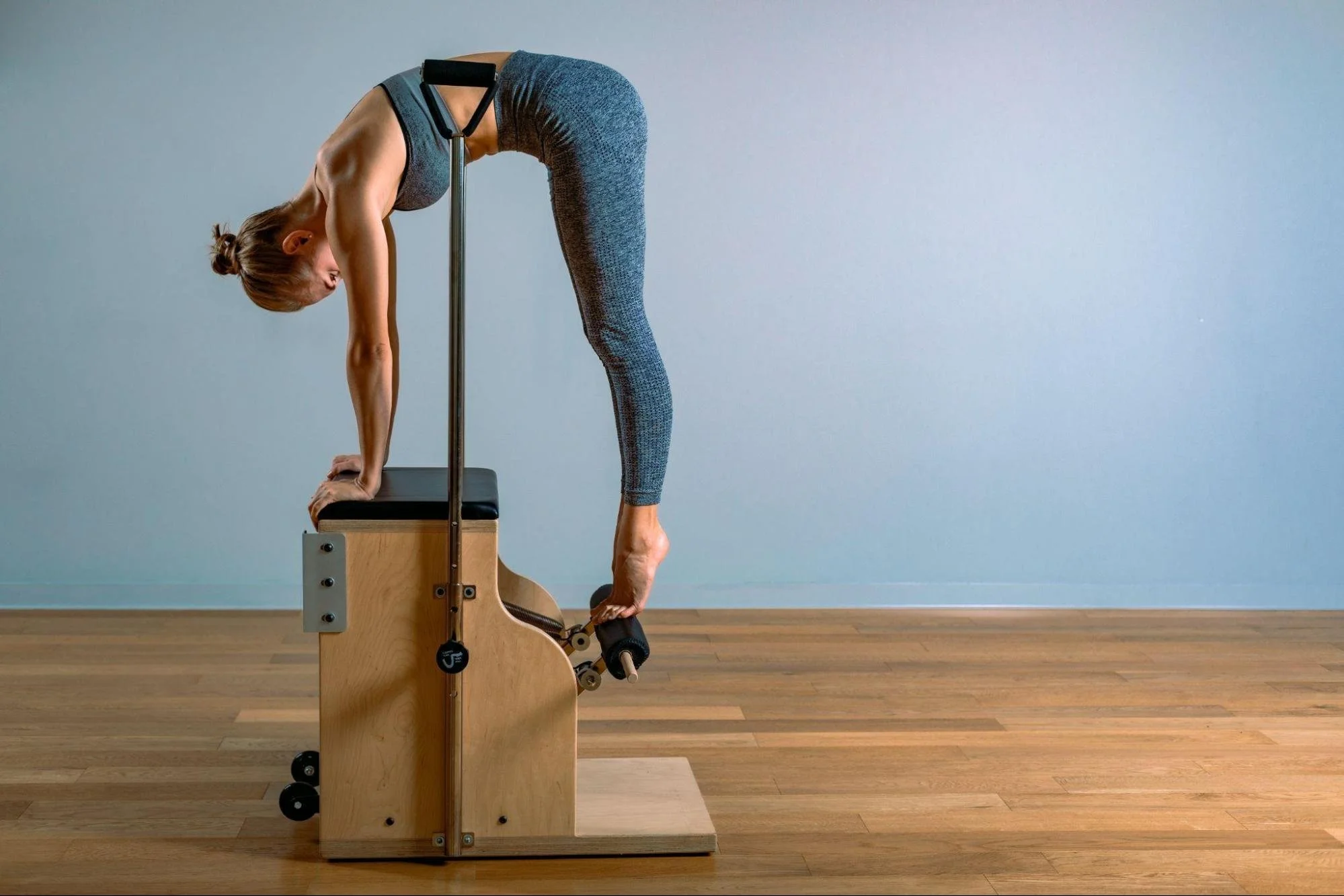
Do you find yourself moving through your Reformer sessions with growing ease but less sense of progression? Do you feel stronger in class but notice that certain movements, anything requiring balance, unilateral control, or stability under load, still expose gaps you cannot quite close? If the Reformer has taken you far and you are ready for what comes next, the Wunda Chair is worth knowing.
What Is Wunda Chair Pilates?
The Wunda Chair is a compact, spring-loaded apparatus originally designed by Joseph Pilates. Its defining feature is a weighted pedal operated by the feet or hands against adjustable spring resistance, which can be modified to support or challenge the body depending on the exercise and the individual.
Unlike the Reformer, where most exercises are performed lying or seated on a sliding carriage, the Wunda Chair positions the body upright and weight-bearing for many of its exercises, which changes the demand on the body entirely.
MERRITHEW™ has refined the original design with updated engineering that allows more precise spring tension and greater versatility across the exercise repertoire. The MERRITHEW™ Wunda Chair is the apparatus we use at Breathe Pilates, and it is equally at home in fitness and clinical Pilates contexts.
Benefits of the Wunda Chair
Most people who practise Pilates regularly are familiar with the Reformer. The Wunda Chair, by contrast, may be underestimated, and that is largely because its demands are not obvious until you are on it.
The upright, weight-bearing nature of Wunda Chair exercises means the body cannot rely on the support that the Reformer's carriage provides. Stabiliser muscles have to work harder, balance and control are tested more directly, and asymmetries between the left and right side of the body become much harder to compensate around.
So is the Wunda Chair harder than the Reformer? Not categorically, but it challenges the body differently, and in doing so, it exposes weaknesses that supported Reformer positions can quietly mask.
It is particularly effective for hip stability, shoulder strength, spinal control and what is often called foot-to-core connectivity: the chain of activation that travels from the foot through the ankle, knee, hip and into the deep core. In clinical Pilates settings, the Wunda Chair is valued for lower limb rehabilitation, balance training and postural correction, precisely because it loads these patterns in a functional, upright position.
Learn more about the differences between Chair and Reformer Pilates here.
Pilates Wunda Chair Exercises to Know
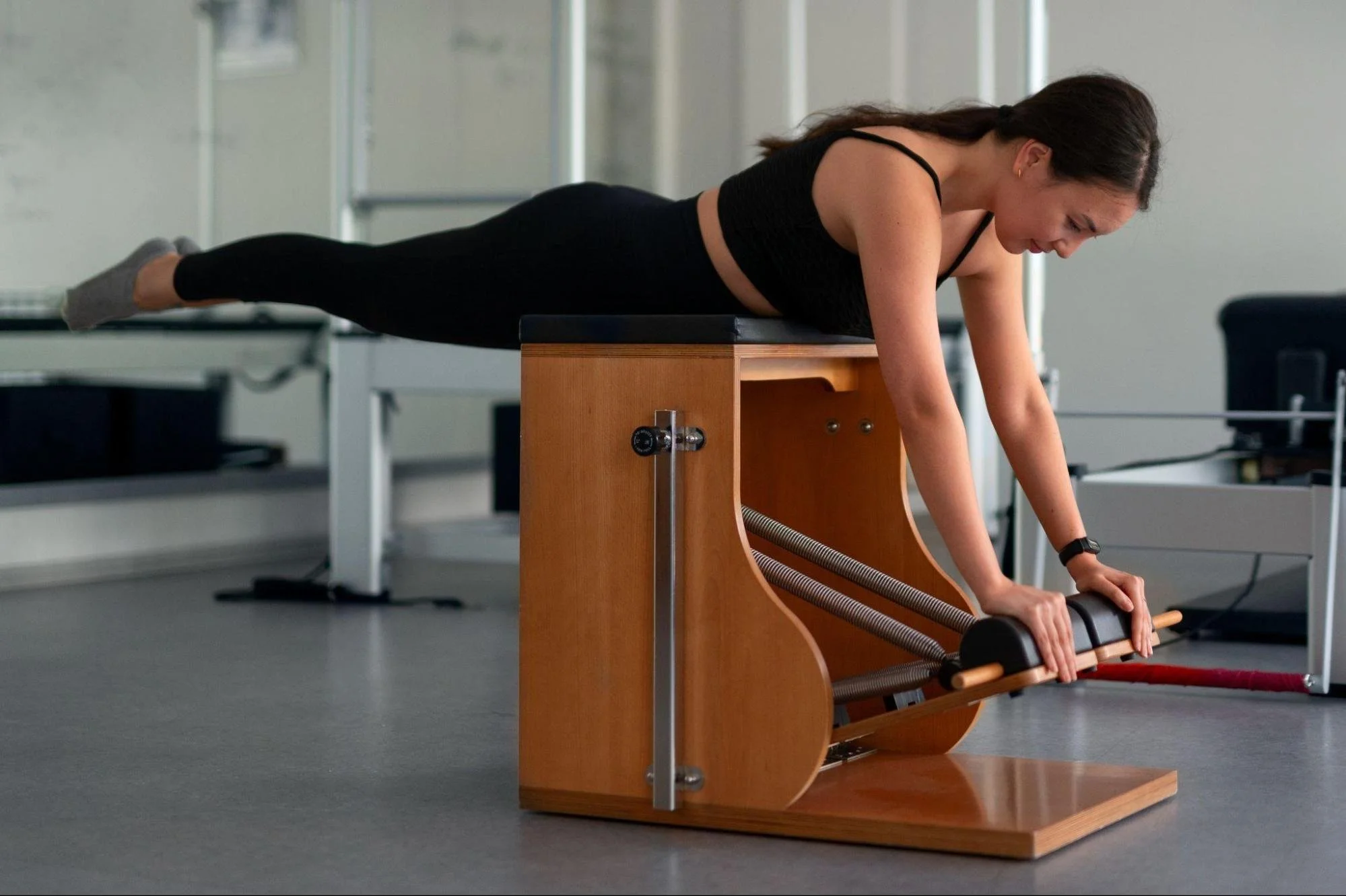
The Wunda Chair's range is wider than most people expect. Foundational exercises include standing footwork, which builds lower limb strength and alignment from the ground up; pike, which demands deep core control and shoulder stability under load; swan, which works thoracic extension and back strength; side sit, which challenges lateral stability and oblique control; and a range of arm press variations that develop shoulder strength and scapular control in ways the Reformer approaches differently.
Each of these has a Reformer equivalent, but the Wunda Chair's version tends to demand more from the stabilisers and less from momentum. The apparatus scales significantly in difficulty. The same Chair that supports a client returning from a lower limb injury with gentle, assisted footwork can challenge an advanced practitioner with unassisted pike variations that require considerable strength and control.
Correct setup matters here more than on most apparatus. Spring tension, foot and hand placement, and body positioning all affect both the effectiveness and the safety of the exercise, which is why working with a trained instructor, particularly when you are new to the Chair, is essential rather than optional.
Is the Wunda Chair Right for You?
If you are comfortable on the Reformer or are a seasoned practitioner on the mat and looking for a new dimension to your training, the Wunda Chair is a natural progression. It is particularly well-suited to those working toward athletic performance, unilateral strength or improved balance and to those returning from lower limb injury who need functional, weight-bearing rehabilitation work.
At our Pilates studio, we offer a wide range of classes across our five studios, from Pilates Reformer classes and small group sessions to prenatal Pilates classes for expectant mothers. Our MERRITHEW™-trained instructors introduce the Wunda Chair in small group classes and private sessions, assessing how you move and selecting exercises that match your current ability and goals. Whether you are building on an established practice or working through a specific area of concern, the environment is the right one: attentive, considered and properly equipped.
If you are ready to explore what it can do for your practice, speak to us at your next session, call us on +65 6571 0665, text us on WhatsApp at +65 9835 5683, or reach out with a message to find out how to get started.